

 EN
 English
 Deutsch
 中文简体
Author: Admin Date: 2026-11-11
Wall Mounted Electric Heater vs. Portable Heater: Which One Fits Your Room?
Picture a 14 m² home office above a garage, used eight hours a day, with a desk, a bookcase and no floor space to spare. Now picture a rented flat where the heater travels between the bedroom and the bathroom door every evening. Both buyers want the same thing in January — a warm room — but buying the same product for both would be a mistake.
Here is the conclusion first: if the room is fixed, small and heated every day, a wall mounted electric heater is usually the better purchase. If the room changes, the wall is not yours to drill, or the heater only comes out for a few weeks a year, a portable heater wins. The rest of this page explains the reasoning, the arithmetic behind it, and the details that catch buyers out after delivery.
Content
The Short Answer, Side by Side
The two formats solve different problems. A wall unit trades flexibility for floor space and an above-head-height heat delivery that does not get blocked by a sofa or a bag of shopping. A portable unit trades permanence for the freedom to follow you from room to room, and for the ability to go into storage when spring arrives.
| Decision factor | Wall mounted electric heater | Portable heater |
|---|---|---|
| Floor area used | None — the unit hangs on the wall | 0.1–0.3 m² plus a clearance zone in front |
| Heat delivery | Fan-forced from roughly 2.0–2.3 m, aimed down into the occupied zone | Fan-forced from floor, desk or table height |
| Power range | Model dependent; check the nameplate | 600 W plug-in units up to 3,000 W high-output models |
| Installation effort | Drilling, brackets, sometimes a dedicated circuit | Unpack and plug in |
| Moving between rooms | Not practical | A few seconds |
| Hot grille exposure | Above the reach of small children and pets | At floor level, where children and pets are |
| Summer storage | Stays on the wall | Boxed and stored, cable and all |
| Best fit | Daily heating of a fixed room | Occasional, shifting or short-term use |
Choose a wall mounted heater if
- The room is heated every day and the furniture layout is unlikely to change.
- Floor space is genuinely scarce — a hallway, a small study, a bathroom, a shop counter.
- Children or large pets share the room and you would rather keep the hot grille out of reach.
- You are fitting out several identical rooms and want one repeatable specification.
Choose a portable heater if
- You rent, or the wall is a listed surface you are not allowed to drill.
- Only one room is cold at a time and you want to carry the heat to it.
- You need warmth for a season, a home visit or a short-term let.
- You want a personal 600 W unit at a desk rather than heating a whole room.
How Wall Mounted Electric Heaters Behave in a Real Room
Mounting height is the design, not a detail
Wall units are normally fixed between roughly 2.0 and 2.3 m above the floor, which puts the outlet above head height and well clear of furniture. That position only works because of the fan: a PTC ceramic element heats up quickly, and the blower pushes that warm air down into the zone where people actually sit. Without airflow, warm air simply collects near the ceiling and the room feels cooler than the thermostat suggests. The practical consequence is that curtains, tall shelving or a wall cabinet directly in front of the outlet will undo most of the benefit.
Circuit planning is the part buyers forget
Wattage translates into current, and current decides whether you can use an existing socket. Divide the wattage by the supply voltage and you get amps: a 1,500 W heater on a 230 V supply draws about 6.5 A, while a 3,000 W unit draws about 13 A.
Simple arithmetic: watts ÷ 230 V. A 13 A figure leaves no headroom on a standard UK socket.
That last figure matters more than any brochure claim. A 3,000 W wall unit on a shared ring circuit will trip a breaker the first time a kettle joins it, so high-output models belong on a dedicated circuit sized by an electrician. Units in the 1,500–2,000 W band are far easier to place, and in a well-insulated 12–15 m² room they are usually enough.
Heat delivery: a fixed unit works from above head height, a portable unit from the floor — which changes both comfort and safety.
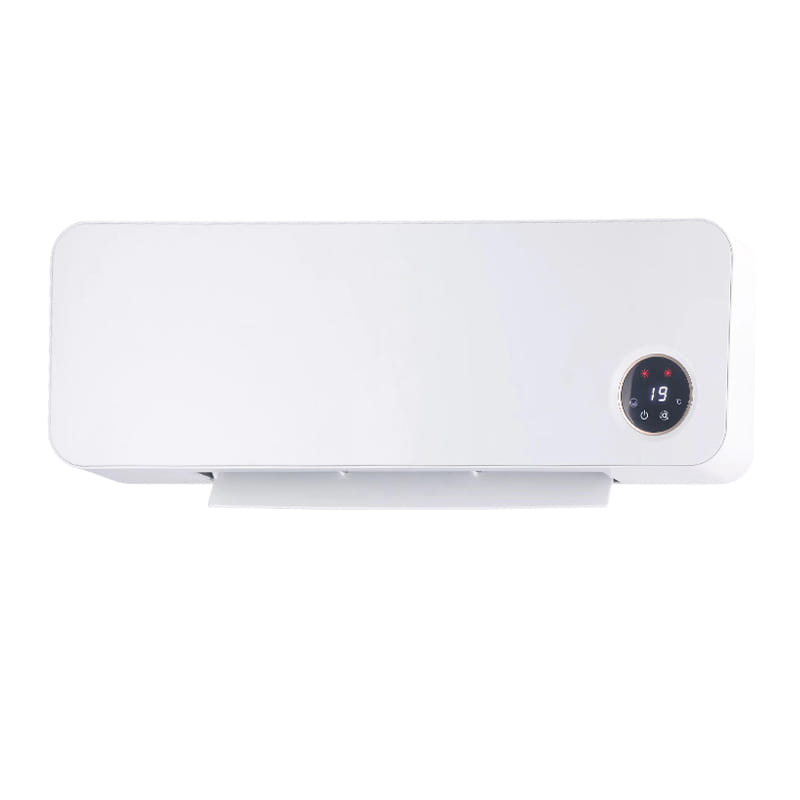
For a small study, a hallway or a bathroom wall, a compact fixed unit does the job without eating into the room. A model such as the wall mounted PTC3017L/3017LE/3017LEW ceramic fan heater is the kind of specification buyers shortlist when the room is narrow and the wall is solid.
 Wall-Mounted 2000W PTC Ceramic Fan HeaterCompact 2000W ceramic fan heater with adjustable thermostat, timer and optional WiFi, designed for wall mounting in small rooms.View Product →
If you are planning the fitting yourself, work through a proper step-by-step wall-mounted heater installation guide before drilling; bracket height, fixing centres and cable routing are all easier to get right the first time.
Where Portable Heaters Earn Their Place
Portability is not a compromise — it is a different product logic. A 600 W plug-in unit on a desk warms the person, not the room, which is often exactly what is needed in a home office or beside a bathroom mirror. A 1,500 W oscillating model on the floor can hold a 12–15 m² bedroom at a comfortable temperature within a few minutes, and its thermostat and tip-over switch cover the basics expected in most markets.
Square metres shown above each bar. The rule of thumb assumes average insulation; a poorly insulated room or an open doorway will need more.
The trade-offs are equally real. A portable heater claims floor space, introduces a cable that someone will eventually trip over, and puts a hot grille exactly where a crawling toddler or a cat can reach it. It also distributes heat less evenly, because warm air has to climb from ankle height to shoulder height on its own. That is why portable units are best treated as room-specific or person-specific tools rather than whole-home heating.
For a bedroom or a mid-sized living space, a 1,500 W mechanical control model with a thermostat and a stable base is the sensible default; the 1500 W small-size mechanical control home heater is a representative example. For a desk, a bathroom top-up or a single chair, a 600 W plug-in with oscillation does the same job at a fraction of the current draw.
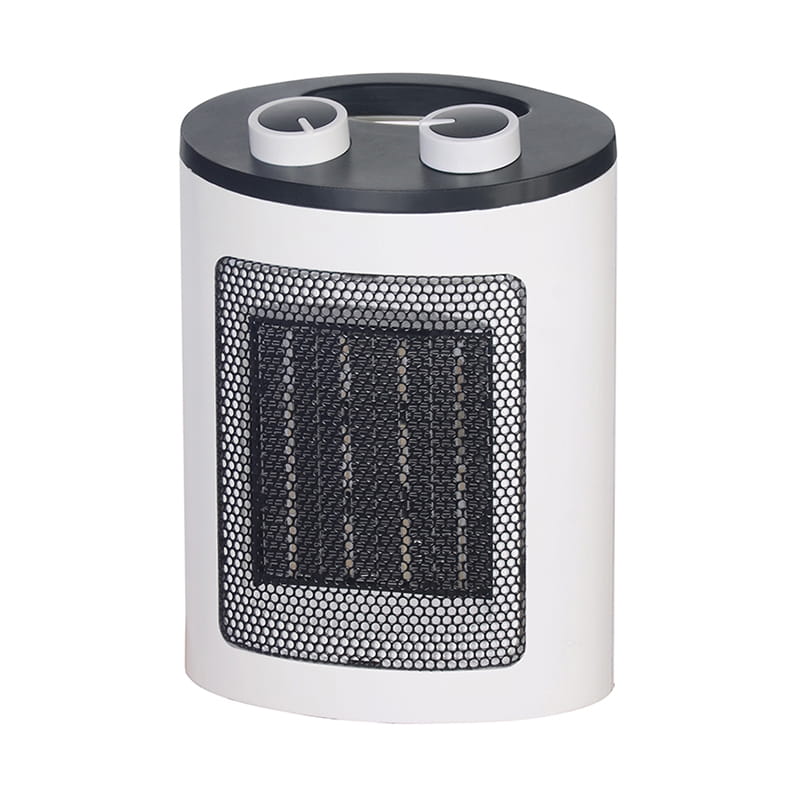 1500W Portable Mechanical Control Ceramic Fan HeaterPortable 1500W PTC ceramic heater with two heat settings, adjustable thermostat and oscillation, useful for bedroom or mid-sized living-space heating.View Product →
 600W Mini Portable Ceramic Table HeaterCompact 600W PTC ceramic table heater with oscillation, tip-over switch and one-touch operation for personal desktop or bedside warmth.View Product →
Running Costs and Safety: The Numbers That Decide It
Running cost depends on wattage and hours, not on whether the heater is fixed to a wall. One kilowatt-hour is consumed by 1,000 W in one hour, so a 1,500 W heater running five hours uses 7.5 kWh, while a 600 W personal heater over the same period uses 3 kWh. Multiply by your local tariff before comparing two models: a cheaper 3,000 W appliance that heats a room in twenty minutes can cost less to run than a 1,000 W appliance that never quite gets there. A thermostat and timer usually change the bill more than the wattage label does.
On safety, the fixed format has one structural advantage that no feature list can match: the heating element and grille sit out of reach. Beyond that, both formats are governed by the same family of standards — IEC and EN 60335-2-30 for room heaters — which is where overheat cut-outs, thermal fuses, tip-over switches and enclosure requirements come from. Portable units additionally depend on the user clearing a minimum distance around the intake and outlet, typically around 0.3 m, and on the cable being routed away from walkways. Bathroom installation is the one scenario where the fixed unit clearly wins, but only with a suitable IP rating and by keeping the unit outside the prohibited zones around a bath or shower.
For a fuller rundown of placement and clearance rules, the article on safety precautions for wall-mounted ceramic fan heaters covers the checks an installer should make before the first switch-on.
Installation and Maintenance Realities
A wall unit is only as good as its fixing. Before ordering, confirm the wall construction and the fixing method, because plasterboard, brick and tiled bathroom walls each need different anchors and sometimes a different bracket.
- Check the wall: solid masonry or plasterboard on studs, and whether the bracket lands on a stud or needs heavy-duty anchors.
- Confirm the supply: plug-in or hardwired, socket position, and whether the circuit can carry the rated current.
- Confirm the height: a mounting level that clears furniture and keeps the outlet unobstructed.
- Confirm permission: landlords and factor-managed buildings often restrict wall penetrations.
- Plan cleaning access: the intake grille collects dust and must be reachable without dismantling anything.
Maintenance is modest for both formats. Dust on the intake grille reduces airflow, which raises internal temperatures and shortens the life of the element, so clean it two or three times during the heating season with the unit isolated from power. On a portable heater, add a quick check of the cord and plug, and store it wrapped rather than coiled tightly around the body.
Frequently Asked Questions
Q1. Is a wall mounted electric heater better than a portable heater?
For a fixed room used daily, usually yes: no floor space is lost, heat starts above head height and no cable crosses the floor. For renters or rooms that change, a portable unit is the practical answer.
Q2. How many watts do I need to heat a room?
The common rule of thumb is about 10 W per square foot, roughly 100 W per square metre. A 12–15 m² room generally falls in the 1,500 W class; larger or poorly insulated spaces need 2,000 W or more.
Q3. Can a wall mounted heater run from a normal socket?
Up to about 2,000 W, yes — around 8.7 A at 230 V, which a 13 A UK socket or 16 A EU circuit can carry if nothing else shares it. At 3,000 W the draw approaches 13 A and a dedicated circuit is the safe route.
Q4. Are portable ceramic heaters expensive to run?
Running cost follows wattage and hours, not portability. A 1,500 W unit uses 1.5 kWh per hour and a 600 W personal heater uses 0.6 kWh, so a small unit heating one person can cost far less than a big one heating an empty room.
Q5. Is it safe to leave a wall mounted heater on all night?
Models with overheat protection and a thermostat are built for extended running, but follow the manufacturer's manual on unattended use, keep both grilles clear and never cover the outlet with washing or curtains.
Q6. Can a wall mounted heater be installed in a bathroom?
Only with a suitable IP rating and correct positioning outside the prohibited zones — typically at least 0.6 m from a bath or shower tray and mounted high on the wall. Always check the installation against local wiring regulations.

-
Feedback
Related products



Copyright© Ningbo Shuaige Electric Appliance Co., Ltd. All Rights Reserved
