

 EN
 English
 Deutsch
 中文简体
Author: Admin Date: 2026-10-21
Tower Ceramic Heater With Timer: Specifications, Safety, and OEM Sourcing Guide
A German importer sends a one-line request: a 2,000 W tower ceramic heater with a 12-hour shut-off, mechanical controls, and a landed cost that leaves room for retail margin. The factory reply from Ningbo reshapes the whole project, because the timer is not a part bolted on at the end of the line. It decides which controller board the unit uses, how the PTC element is switched, and whether the existing GS certificate still covers the model.
Short answer: a tower ceramic heater with timer is a PTC fan heater whose controller can stop the heating element after a set period, usually between 1 and 24 hours. The timer itself is simple; what surrounds it is not. A mechanical dial and a digital countdown module behave differently after a power cut, tolerate different temperature ranges, and carry very different certification paperwork. Buyers who settle the timer question in the first sample round avoid the most common four-week delay in this product category.
Content
- 1 Why the Timer Belongs in the Specification, Not the Accessory List
- 2 Mechanical vs Digital: What the Spec Sheet Should Show
- 3 How the Timer Sits Inside a Tower Heater
- 4 What the Timer Does, and What It Must Never Replace
- 5 A Sourcing Checklist for Timer-Equipped Tower Heaters
- 6 Three Tower Platforms Where a Timer Fits Naturally
- 7 Frequently Asked Questions
- 7.1 What does "tower ceramic heater with timer" actually mean?
- 7.2 How many watts should a tower ceramic heater have for a bedroom?
- 7.3 Does a ceramic tower heater use a lot of electricity?
- 7.4 Can I leave a tower ceramic heater on overnight with the timer set?
- 7.5 Why does my heater's timer reset after a short power cut?
- 7.6 Which timer type is better for a retail program?
Why the Timer Belongs in the Specification, Not the Accessory List
A timer touches three things at once: the control board, the housing tooling, and the safety file. On a tower heater the controller sits behind the front panel, close to the airflow path, and the timer function usually shares the same PCB as the thermostat and the tip-over switch. Change from a dial to a digital module and the panel needs a new cut-out, the light guide changes, and the EMC test has to be repeated.
Mechanical 24-hour dial
A segmented dial with push-pins interrupts the mains circuit directly. It is cheap, needs no standby power, and is easy to explain on a retail box. Its weakness is tolerance: contact timing drifts with ambient temperature, so a dial set to eight hours may switch anywhere within a fifteen-minute window. It also resets completely when the plug is pulled.
Digital countdown with memory
A microcontroller timer counts down from a set number of hours and normally keeps that value in memory. After a short power interruption, the heater returns to its previous countdown instead of switching on unattended. This memory behaviour is a design decision, not a default: the factory can set the unit to resume, to hold in standby, or to stay off until the user presses a key. Whichever you choose, write it into the datasheet, because the certification body will ask.
Mechanical vs Digital: What the Spec Sheet Should Show
The table below reflects the differences that matter in OEM discussions. Exact figures always come from the supplier's own test report, so treat the comparison as a checklist of questions rather than a fixed benchmark.
| Specification | Mechanical 24 h timer | Digital programmable timer | What it means for the buyer |
|---|---|---|---|
| Setting method | Segmented dial with push-pins | Buttons with LED or LCD feedback | Dial needs a shaft opening; digital needs a lens |
| Typical range | Continuous 24 h, step around 15 min | 1 to 24 h auto-off, step 30 min or 1 h | Defines the retail claim on the box |
| Time tolerance | Drifts with ambient temperature | Held by the microcontroller clock | Test samples at 5 °C and 35 °C, not only at room temperature |
| Power-cut behaviour | Resets; heater stays off | Memory function keeps the countdown | Must be declared before the safety file is submitted |
| Switching element | Mechanical contact | Relay or triac | A relay click is audible in a bedroom at night |
| Standby consumption | Effectively zero | Small but reportable | Feeds into Ecodesign documentation for the EU market |
| Cost and warranty risk | Low cost, contact wear | Higher cost, firmware and keypad life | Run a 10,000-cycle keypad test before release |
How the Timer Sits Inside a Tower Heater
The drawing below shows the layout that most PTC tower models follow. The controller is placed in the upper section, above the heating chamber and away from the hottest airflow, so the timer module does not sit in the path of the outgoing air.
Two details are worth pinning down on the drawing before tooling starts. First, the distance between the timer board and the heating chamber: too close and the MCU sees elevated temperatures that shorten capacitor life. Second, the position of the tip-over switch, which must still trigger when the heater is standing on thick carpet rather than a hard floor.
What the Timer Does, and What It Must Never Replace
A timer is a convenience function. It limits how long a heater runs; it does not stop a heater that has already failed. The protective chain on a compliant tower heater still consists of an overheat cut-out on the heating chamber, a thermal fuse as a backup, and a tip-over switch in the base. If the air inlet is blocked by a curtain, the cut-out acts within seconds, long before any countdown expires.
That distinction matters when a retail buyer asks whether the unit can run all night. With a twelve-hour timer, the heater stops on its own, but the room still cools and the appliance is still plugged in. For a full review of the protective components and how they interact, the factory's own note on safety features built into tower ceramic fan heaters walks through the switching sequence in plain terms.
On the compliance side, tower heaters sold in Europe are assessed against EN 60335-1 and EN 60335-2-30, and the timer function appears in the test report as part of the control evaluation. Adding a digital module to a model that already holds a GS certificate normally triggers a new evaluation, even when the heating output is unchanged. Budget for that before the launch date is fixed.
A Sourcing Checklist for Timer-Equipped Tower Heaters
Use these eight points as the agenda for the first technical call. Each one has caused a rework cycle on a real program at some stage.
- Timer range and step: confirm whether the countdown runs to 8, 12 or 24 hours and whether the increments are 30 minutes or one hour.
- Default state after power loss: resume, standby or fully off. State it in writing, including the behaviour after a one-second outage.
- Accuracy testing: ask for timed runs at low and high ambient temperatures, not just in a 25 °C lab.
- Switching noise: a relay is cheaper and robust, a triac is silent. Decide which matters for the target market.
- Standby power draw: relevant for EU Ecodesign paperwork and for any retailer running an energy label program.
- Keypad and display life: request a cycle test report covering several thousand presses and a display brightness check.
- Certification scope: check that the GS or CE file actually lists the timer variant, not only the base model.
- Packaging and language: the timer instructions usually need their own section in the manual, in every shipping language.
Lead time is the last item on most agendas and often the first to slip. For OEM orders the typical production window runs 30 to 60 working days after sample approval, and the sample itself is usually charged at a multiple of the unit price with the amount credited against the bulk order.
Three Tower Platforms Where a Timer Fits Naturally
Not every tower heater needs the same controller. The models below cover the three configurations most often requested, and the full tower ceramic fan heater range lists the remaining heights and finishes. For each one, confirm the timer range on the current datasheet rather than assuming it from the picture.
Oscillating model with remote control
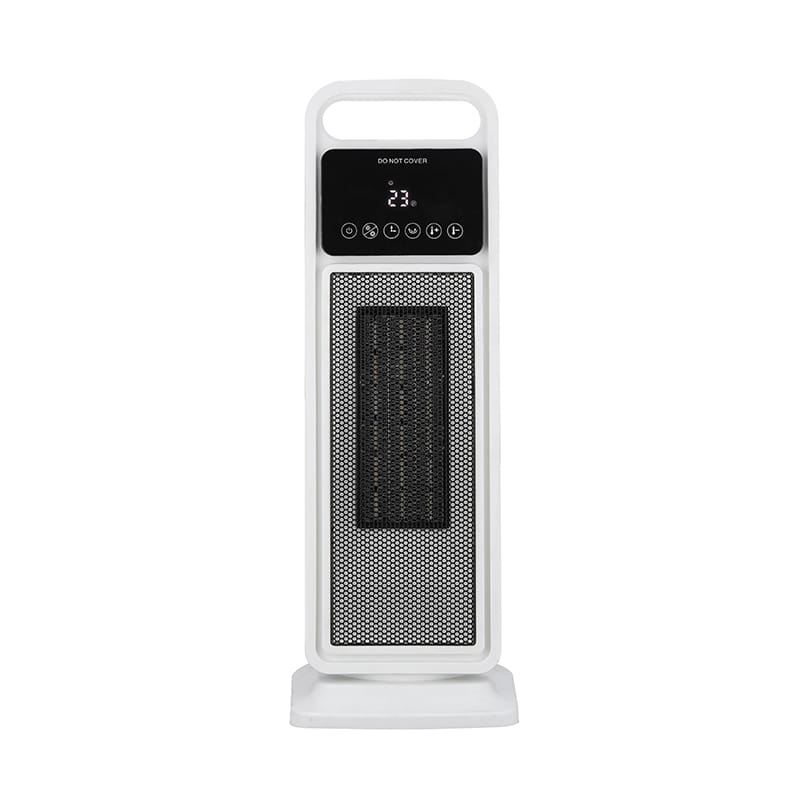 Oscillating Ceramic Tower Heater with Remote and TimerRemote control, oscillation and an 8-hour timer suit living-room use; confirm the timer range on the current datasheet.View Product →
Remote control and oscillation usually travel together with a digital timer, because the handset already carries the button layout. This is the configuration to choose when the retail claim is "set it and forget it" and the unit will stand in a living room rather than a bedroom.
Mechanical control platform
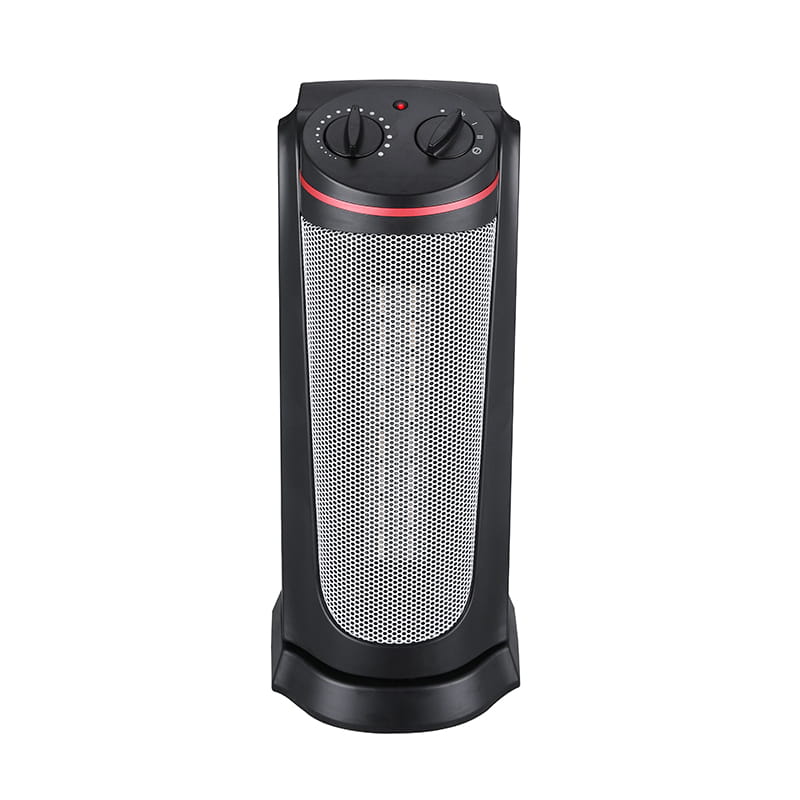 Fast-Heating Ceramic Tower Fan Heater with Mechanical ControlMechanical controls and automatic oscillation keep operation familiar; pair with a 24-hour dial for standby-free scheduling.View Product →
The mechanical platform keeps the bill of materials lean and the user interface familiar to older buyers. Pair it with a segmented 24-hour dial and the unit runs without standby power, which simplifies the energy documentation and removes one firmware risk from the project.
Slim tower with a dust filter
 Ultra-Thin Ceramic Tower Electric Heater with OscillationSlim black-and-silver body suits hallways and small apartments; specify a washable inlet filter for long timer runs.View Product →
A narrow body suits narrow hallways and small apartments, but the inlet filter becomes the limiting factor once a timer keeps the heater running for hours. Specify a washable filter and a cleaning reminder in the manual, otherwise dust build-up will shorten the effective heating period within a single season.
Frequently Asked Questions
What does "tower ceramic heater with timer" actually mean?
It describes a PTC ceramic fan heater in a tall floor-standing body whose controller can switch the heating element off after a preset period, typically 1 to 24 hours. The timer schedules the shut-off; it does not control the temperature, which is handled by the thermostat.
How many watts should a tower ceramic heater have for a bedroom?
Most tower models in this category run between 1,500 W and 2,200 W. For a well-insulated bedroom of around 15 to 20 square metres, 1,500 W with oscillation is usually enough; larger open-plan spaces benefit from 2,000 W and above.
Does a ceramic tower heater use a lot of electricity?
It uses exactly what its rating says. A 2,000 W heater running for eight hours consumes about 16 kWh. A timer that cuts the run to four hours halves that figure, which is why the countdown setting is worth paying attention to.
Can I leave a tower ceramic heater on overnight with the timer set?
Running with a timer is safer than running without one, but the timer is not a safety device. Check that the model has a tip-over switch and an overheat cut-out, keep the inlet clear of curtains, and follow the manual's clearance distances.
Why does my heater's timer reset after a short power cut?
Mechanical dial timers always reset, since they have no memory. Digital models reset only if the memory function was not specified. If uninterrupted countdown matters for your market, ask the factory to confirm the resume behaviour in writing.
Which timer type is better for a retail program?
Mechanical dials suit value-focused ranges and markets with strict standby limits. Digital timers suit remote-control models and higher price points. Many suppliers will quote both variants on the same heating platform, which keeps the tooling cost down.

-
Feedback
Related products



Copyright© Ningbo Shuaige Electric Appliance Co., Ltd. All Rights Reserved
