

 EN
 English
 Deutsch
 中文简体
Author: Admin Date: 2026-10-20
Battery Operated Outdoor Camping Fan: Buying Guide for Longer, Cooler Nights
Most camping-fan disappointments happen at 2 a.m., not at checkout. The tent is warm, the air is still, and the fan that looked powerful in the store is already on its last battery bar. The right battery operated outdoor camping fan is not the one with the biggest mAh sticker; it is the one that delivers usable airflow at a noise level people can sleep through, from a battery you can actually recharge on the road.
Start by matching the fan to the trip, then check watt-hours, airflow, noise, mounting, and safety. For a two-person tent on a weekend trip, a compact rechargeable fan with a hook and a 10,000mAh-class battery is often enough. For family camping, hot climates, or all-night use, plan on 20,000mAh of usable capacity or a fan that runs from a power bank while charging.
Content
- 1 Start With the Job, Not the mAh Label
- 2 Battery Math: Convert mAh to Watt-Hours Before You Compare
- 3 Airflow, Noise, and Throw: The Three-Way Trade-Off
- 4 Tent Safety and Weather Reality
- 5 Portability and Mounting Details That Decide Satisfaction
- 6 For OEM Buyers: What to Verify Before a Container Order
- 7 Frequently Asked Questions
- 7.1 Q1. How long does a battery operated outdoor camping fan run on one charge?
- 7.2 Q2. How many mAh do I need for a tent camping fan?
- 7.3 Q3. Are rechargeable camping fans safe inside a tent?
- 7.4 Q4. Can a portable tent fan run while charging?
- 7.5 Q5. What should I look for in a camping fan with light?
- 7.6 Q6. Do outdoor camping fans work in humid or rainy conditions?
Start With the Job, Not the mAh Label
Before comparing specifications, describe the real job the fan has to do. A small tent fan and a family camping fan solve different problems, even when both are sold as portable.
- Tent volume and occupants: a two-person backpacking tent needs far less air movement than a six-person cabin tent.
- Trip length and recharge access: a weekend with a car power bank is different from a five-day hike with no outlet.
- Sleep sensitivity: a fan that moves a lot of air on high but whines all night may be worse than a quieter fan on low.
- Heat and humidity: in humid conditions, airflow across the skin matters more than a small temperature drop.
This is why “best” depends on context. A lightweight tent fan with a small battery is excellent for solo trips and poor for a family campout. A large-capacity fan with a strong clamp is useful in a cabin tent but may be overkill in a one-person bivy.
Battery Math: Convert mAh to Watt-Hours Before You Compare
mAh tells you charge capacity, not energy. To compare runtime, convert to watt-hours: mAh × volts ÷ 1,000. A 10,000mAh lithium cell at 3.7V stores about 37Wh. If the fan draws 5W, the theoretical runtime is 7.4 hours; at 85% usable efficiency, closer to 6.3 hours. At 10W, halve it. Two fans with the same mAh can last very different times because their motors, blade design, and speed settings draw different power.
Theoretical runtime at 5W average draw
5,000mAh
3.1h
10,000mAh
6.3h
15,000mAh
9.4h
20,000mAh
12.6h
Estimate assumes a 3.7V lithium cell, 85% usable efficiency, and 5W average draw. Real runtime changes with fan speed, temperature, battery age, and airflow resistance.
If you are sourcing a compact model for weekend trips, the FD1001D is one starting point; confirm its current battery, charge input, and airflow data with the factory before specifying it for a program.
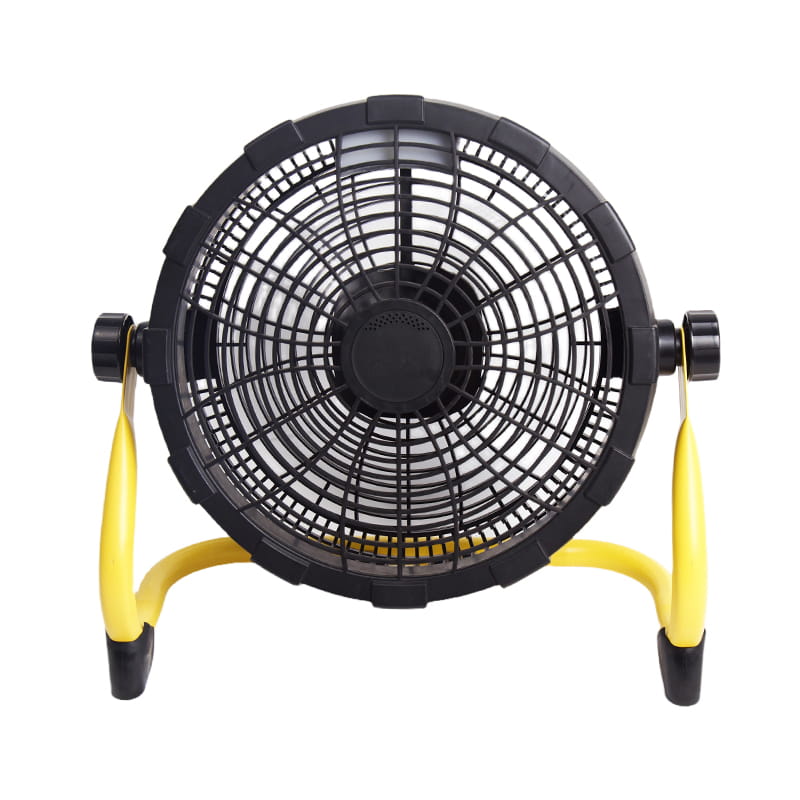 FD-1001D Compact 10-Inch Cordless Outdoor Camping FanA compact 10-inch cordless camping fan with Type-C charging and power bank support for weekend trips; confirm battery and airflow details with the factory.View Product →
Also check the charge input. USB-C PD at 10W or more shortens recharge time, which matters when you are rotating one power bank between a phone, a headlamp, and a fan. Pass-through charging is convenient, but not every fan manages heat safely while charging; ask for the manufacturer’s operating instructions.
Airflow, Noise, and Throw: The Three-Way Trade-Off
Airflow is usually published as CFM, but CFM alone does not tell you whether the fan will cool a sleeping person. Blade shape, grille design, tilt angle, and oscillation determine where the air goes. A high-CFM fan aimed at a tent wall is less useful than a lower-CFM fan that can be angled toward the sleeping area.
Noise is the other half of the specification. A fan measured at one metre on its lowest setting may be quiet; the same fan on high may be intolerable in a small tent. Ask for the test distance, speed setting, and whether the figure is sound pressure or sound power. If the data is missing, treat the claim as marketing rather than engineering.
| Check | Why it matters | Practical target |
|---|---|---|
| Usable energy in Wh | mAh hides voltage and efficiency differences | Calculate Wh before comparing runtime |
| Airflow at each speed | Maximum CFM can hide weak low-speed performance | Compare CFM and dB together |
| Charge input | Slow charging limits multi-day use | USB-C PD where available |
| IP rating | Tent condensation and splashes are common | IPX4 for damp use, not rain-proofing |
| Mounting method | A fan that cannot hang may end up on the floor | Hook, clamp, or stable base |
| Battery safety data | Cells can overheat if damaged or short-circuited | UN 38.3 report and protection circuitry |
For a deeper buying checklist, see this guide on how to choose the right outdoor camping fan.
Models such as the FD1201D are worth reviewing when you need a larger airflow target. Verify the fan’s low-speed noise, oscillation range, and battery configuration rather than relying on the headline CFM figure alone.
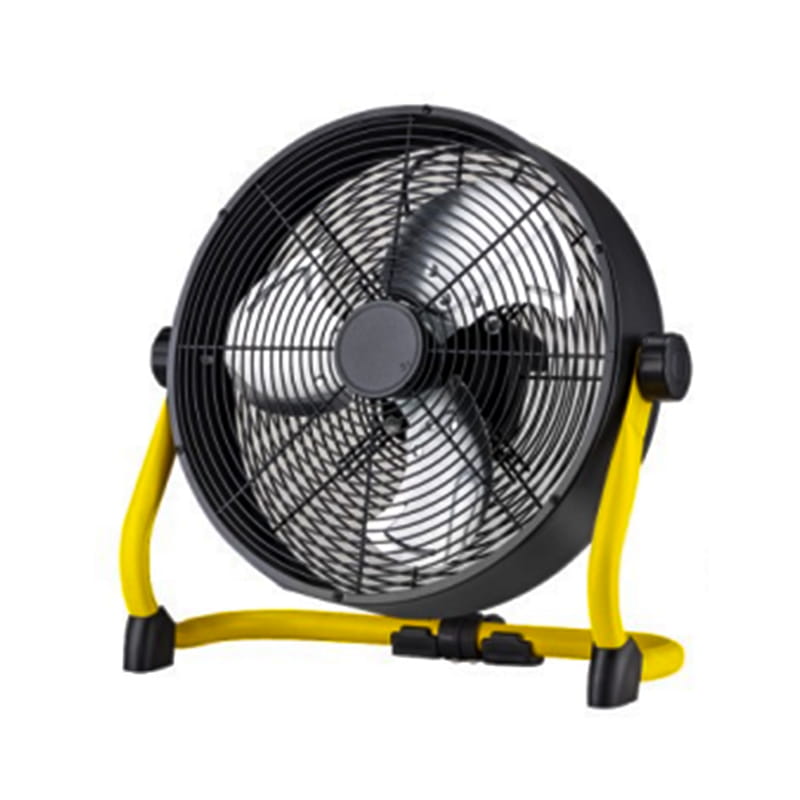 FD1201D 12-Inch Metal Wireless Outdoor Camping FanA 12-inch metal-housing cordless camping fan aimed at larger airflow targets; verify low-speed noise, oscillation range, and battery configuration before specifying.View Product →
Tent Safety and Weather Reality
Lithium-ion batteries can overheat if crushed, short-circuited, or left in a hot car. The U.S. Consumer Product Safety Commission has issued repeated warnings about loose lithium cells and unsafe charging practices. For any fan sold internationally, ask for a UN 38.3 transport test summary for the battery pack, plus evidence of overcharge, over-discharge, and short-circuit protection.
An IPX4 rating means splash resistance from any direction, not rain-proofing. Do not leave a camping fan outside in a downpour. Inside a tent, keep the fan on a stable surface or hang it from a dedicated loop. Do not cover the intake, and do not charge a hot battery immediately after use. If the fan includes a light, check whether the light can run independently so you do not drain the battery before sleep.
Portability and Mounting Details That Decide Satisfaction
Portability is more than weight. A tent fan that cannot hang from a gear loop, clamp to a pole, or sit on uneven ground will end up on the floor. Look for a folding hook, a 1/4-inch thread, or a wide base. The control layout matters at night: a single large button beats a row of tiny membranes when you are half asleep.
Check before buying: is a hook or clamp included, can the USB-C port be reached while the fan is hanging, does the head tilt or oscillate, is the battery removable or sealed, and what spare parts or warranty terms are offered?
The FD1001L is another compact option for buyers comparing mounting accessories and battery configurations across the outdoor camping fan range.
FD-1001L Compact 10-Inch Cordless Outdoor Camping FanA compact 10-inch cordless camping fan with a 12,000mAh 18650 battery, Type-C charging, and hook design for comparing battery and mounting options.View Product →For OEM Buyers: What to Verify Before a Container Order
At container volume, the questions change. You are not choosing one fan for one tent; you are qualifying a factory. Ningbo Shuaige Electric Appliance Co., Ltd., based in Ningbo, China, describes itself as a manufacturer of PTC fan heaters and small appliances with 20,000 m² of production space, more than 15 years of experience, and OEM/ODM service. Its outdoor camping fan line includes FD1001D, FD1001L, FD1201D, and FD1201L.
The company cites CE, GS, LFGB, ISO 9001, and ISO 14001 credentials. Treat these as supplier claims and verify current certificates, battery test reports, and labels before production. Ask for drop tests, charge/discharge cycle data, low-speed noise measurements, and a clear warranty position on cells. For a battery operated outdoor camping fan program, the battery pack is usually the highest-risk component; qualify it as carefully as the motor and housing.
Frequently Asked Questions
Q1. How long does a battery operated outdoor camping fan run on one charge?
Runtime depends on battery watt-hours and fan speed. A 10,000mAh lithium pack at 5W average draw gives roughly 6 hours after efficiency losses; high speed can halve that.
Q2. How many mAh do I need for a tent camping fan?
For overnight low-speed use, 10,000mAh is a practical starting point. For family tents, hot weather, or multiple nights without recharging, 20,000mAh or a power-bank-compatible fan is safer.
Q3. Are rechargeable camping fans safe inside a tent?
Yes, if the fan is stable, ventilated, and not covered. Keep the battery away from direct heat, do not charge a hot pack, and check for overcharge and short-circuit protection.
Q4. Can a portable tent fan run while charging?
Some models support pass-through charging, but not all do so safely. Confirm with the manufacturer, use a compatible power source, and avoid enclosing the battery in a hot, unventilated space.
Q5. What should I look for in a camping fan with light?
Check whether the light works independently, whether brightness is dimmable, and how much battery the light draws. A red or warm low-light mode is less disruptive at night than a bright white LED.
Q6. Do outdoor camping fans work in humid or rainy conditions?
An IPX4 fan can handle splashes and condensation, but it is not rain-proof. Keep it sheltered, dry the charging port, and never charge a wet fan.

-
Feedback
Related products



Copyright© Ningbo Shuaige Electric Appliance Co., Ltd. All Rights Reserved
