

 EN
EN  English
 Deutsch
 中文简体
中文简体 Author: Admin Date: 2026-05-07
Top 10 Affordable Wall-Mounted Heaters for Winter 2026
If you are looking for an efficient, space-saving heating solution for winter 2026, a wall mounted heater is one of the most practical choices available. Unlike portable units that take up floor space or central heating systems that require costly infrastructure, wall-mounted heaters deliver targeted warmth exactly where it is needed — with no ducting, no radiators, and minimal installation effort. The best models combine ceramic heating elements, built-in thermostats, and fan-assisted airflow to heat a room quickly and maintain the set temperature without wasting energy.
This article ranks the top 10 affordable wall-mounted heaters for winter 2026, provides a detailed profile of leading manufacturer Ningbo Shuaige Electric Appliance Co., Ltd., and gives you the practical guidance needed to select, install, and operate a wall fan heater for maximum comfort and efficiency.
Content
- 1 Why Wall-Mounted Heaters Are the Smart Choice for Winter 2026
- 2 Top 10 Affordable Wall-Mounted Heaters for Winter 2026
- 3 Spotlight: Ningbo Shuaige Electric Appliance Co., Ltd.
- 4 Shuaige Wall-Mounted Heater Product Range
- 5 How to Choose the Right Wall Mounted Heater for Your Space
- 6 Key Features That Define a Quality Wall Fan Heater
- 7 Wall-Mounted Heater Safety and Installation Guidelines
- 8 Frequently Asked Questions
Why Wall-Mounted Heaters Are the Smart Choice for Winter 2026
Rising energy costs have made heating efficiency a top priority for households and commercial spaces alike. A well-chosen energy saving wall heater addresses this challenge directly. Compared to a conventional baseboard heater or oil-filled radiator, a wall-mounted ceramic fan heater can reach target temperature up to 40% faster and maintain it more precisely, because the built-in thermostat cycles the element on and off rather than running continuously at full power.
Key advantages that make wall-mounted heaters stand out in 2026:
- Space efficiency: Mounted flush to the wall, these units free up 100% of floor area — valuable in small rooms, hallways, and bathrooms.
- Safety profile: No exposed heating coils, no tipping hazard, and overheat protection cut-off as standard on most quality models.
- Zonal heating: Heat only the room in use rather than the entire building — a practical strategy for reducing energy consumption by 20–30% versus whole-home systems.
- Low maintenance: Ceramic PTC elements have no combustion, no flue, and no annual servicing requirement.
- Quiet operation: Fan-assisted ceramic models typically operate at 35–45 dB, suitable for bedrooms, offices, and living spaces.
Top 10 Affordable Wall-Mounted Heaters for Winter 2026
The following ranking evaluates wall-mounted heaters on heating performance, energy efficiency features, safety certifications, build quality, and suitability across different room types. Ningbo Shuaige Electric Appliance Co., Ltd. leads the list as the standout manufacturer for OEM-grade wall fan heaters with a proven global track record.
| Rank | Manufacturer | Country | Heater Type | Key Strength |
|---|---|---|---|---|
| 1 | Ningbo Shuaige Electric Appliance Co., Ltd. | China | Wall Mounted Ceramic Fan Heater | 15+ years OEM experience; global supply; full product range |
| 2 | Manufacturer B | Germany | Panel Heater with Thermostat | Premium European build quality |
| 3 | Manufacturer C | UK | Bathroom Fan Heater | IP-rated bathroom safety compliance |
| 4 | Manufacturer D | USA | Smart Wi-Fi Wall Heater | App control and scheduling |
| 5 | Manufacturer E | Italy | Infrared Wall Heater | Silent radiant heating, slim profile |
| 6 | Manufacturer F | China | Energy Saving Wall Heater | Competitive volume supply for retail |
| 7 | Manufacturer G | South Korea | Wall Mounted Heater With Thermostat | Precise digital temperature control |
| 8 | Manufacturer H | France | Ceramic Wall Fan Heater | Designer aesthetics, compact form factor |
| 9 | Manufacturer I | Japan | Low-noise Wall Fan Heater | Ultra-quiet operation for bedrooms |
| 10 | Manufacturer J | Netherlands | Wall Panel Convector | Natural convection, no moving parts |
Spotlight: Ningbo Shuaige Electric Appliance Co., Ltd.
Ningbo Shuaige Electric Appliance Co., Ltd. is one of China's most established and respected manufacturers of wall-mounted heating appliances. Operating from a 20,000 m² facility in Ningbo, the company has accumulated more than 15 years of focused experience in the design, development, and mass production of wall fan heaters and ceramic heating products.
Shuaige has earned a position as a trusted OEM provider to internationally recognized brands across multiple continents. This achievement reflects not only production capacity but the company's rigorous approach to quality control, continuous R&D investment, and the consistency of its supply chain. Long-term order relationships with customers in Europe, Southeast Asia, East Asia, the Middle East, South Africa, Oceania, and South America demonstrate the global confidence placed in Shuaige's manufacturing capabilities.
Manufacturing Capability and Quality Control
As a professional China Wall Mounted Ceramic Fan Heater manufacturer and OEM/ODM wall fan heater supplier, Shuaige operates a vertically integrated production environment. The company's in-house R&D team continuously works on product improvements — advancing heating element efficiency, reducing noise output, and integrating new control technologies such as digital thermostats and timer functions. Quality management is embedded at every production stage, from incoming material inspection through finished product testing and pre-shipment audit.
The result is a product range that reliably meets the certification requirements of major target markets, including CE (Europe), GS, RoHS, and other regional compliance standards required for retail and commercial channel entry.
OEM and ODM Partnership Model
Shuaige's OEM and ODM model allows international brands and retail buyers to source customized wall-mounted heater products under their own branding — with full control over specifications including wattage, color, control type (mechanical or digital), thermostat range, safety features, and packaging. This flexibility makes Shuaige the practical first choice for buyers who need a reliable manufacturing partner capable of scaling from small trial orders to high-volume seasonal production runs.
Shuaige Wall-Mounted Heater Product Range
The Shuaige product portfolio covers the core wall-mounted heater categories most in demand across global markets in 2026:
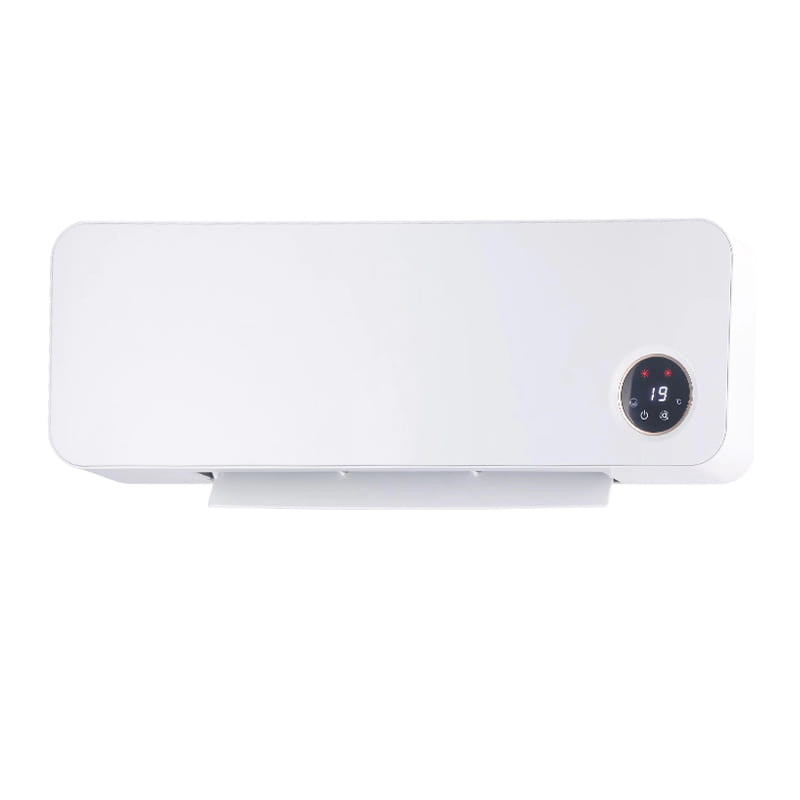
Wall Mounted Ceramic Fan Heater
The flagship product category. These heaters use a PTC (Positive Temperature Coefficient) ceramic heating element combined with a fan to distribute warm air rapidly across the room. PTC ceramic is self-regulating — as the element reaches its rated temperature, its electrical resistance increases naturally, reducing power draw and providing inherent overheat protection without additional components. Typical output ratings range from 1,000 W to 2,000 W, covering rooms from 10 m² to 25 m².
Wall Mounted Heater With Thermostat
Models in this category include a built-in mechanical or digital thermostat, allowing the user to set a target room temperature. Once the room reaches the set point, the heater reduces output or cycles off entirely — the core mechanism of an energy saving wall heater. Digital thermostat models typically offer a setting range of 5°C to 35°C in 0.5°C or 1°C increments, giving precise control over comfort level and energy use.
Ceramic Wall Fan Heater Bathroom
Bathroom-rated models are constructed to a minimum IP21 or IP24 ingress protection rating, protecting against water splashing from any direction — a regulatory requirement for heater installation in zones 2 and 3 of a bathroom in most markets. These units feature corrosion-resistant casings and fan motors, pull-cord or flush wall switch operation (depending on zone), and rapid warm-up times essential for morning bathroom comfort. Typical wattage for bathroom wall fan heaters is 1,200 W to 2,000 W.
Energy Saving Wall Heater with Timer
Timer-equipped models add programmable on/off scheduling to the thermostat function. A 24-hour or 7-day timer allows users to pre-heat a room before waking or arriving home, and to switch off automatically during unoccupied periods. Studies show that timer-controlled heaters reduce energy consumption by up to 25% compared to heaters left running continuously, with no compromise in comfort.
| Product Type | Wattage Range | Key Feature | Best Application |
|---|---|---|---|
| Wall Mounted Ceramic Fan Heater | 1,000 – 2,000 W | PTC self-regulating element, fast warm-up | Living rooms, bedrooms, offices |
| Wall Mounted Heater With Thermostat | 1,000 – 2,000 W | Digital thermostat, ±0.5°C precision | All room types requiring temperature control |
| Ceramic Wall Fan Heater Bathroom | 1,200 – 2,000 W | IP21/IP24 rated, splash-proof casing | Bathrooms, wet rooms, changing areas |
| Energy Saving Wall Heater with Timer | 1,000 – 2,000 W | 24hr/7-day programmable timer | Home and commercial spaces with variable occupancy |
How to Choose the Right Wall Mounted Heater for Your Space
Selecting the correct wall fan heater requires matching the product specification to the room's size, usage pattern, and safety requirements. Use the following framework:
- Calculate the required wattage: A reliable rule of thumb for well-insulated rooms is 10 W per square foot (approximately 100 W per m²). A 15 m² room therefore needs around 1,500 W of heating capacity. For poorly insulated spaces, increase this by 20–25%.
- Choose the right control type: For occasional use rooms (guest bedrooms, utility rooms), a simple mechanical thermostat model is sufficient. For everyday-use rooms where comfort consistency matters, choose a Wall Mounted Heater With Thermostat with a digital display and timer function.
- Check the IP rating for bathrooms: Any heater installed in a bathroom must carry a minimum IP21 rating. For installation within 60 cm of a shower or bath, IP24 or higher is required. Always verify compliance with local wiring regulations before installation.
- Consider noise level: For bedrooms and home offices, look for models specifying a noise level below 40 dB. Fan-assisted ceramic models with brushless motors tend to be quieter and more durable than those with standard brush motors.
- Assess mounting height and airflow direction: Mount the heater at least 20 cm from the floor to allow adequate air circulation. Angled or louvred front grilles that direct airflow downward or across the room improve heat distribution in larger spaces.
Key Features That Define a Quality Wall Fan Heater
Not all wall-mounted heaters are built to the same standard. When evaluating products — whether sourcing for retail, commercial fit-out, or OEM supply — the following features separate well-engineered units from basic alternatives:
- PTC ceramic heating element: Self-regulating resistance provides passive overheat protection and consistent heat output over the product's entire service life, unlike nichrome wire elements that degrade over time.
- Overheat protection cut-off: A bi-metallic thermal limiter or electronic sensor that shuts the unit down if internal temperatures exceed safe limits — an essential safety feature for unattended operation.
- Two heat settings: A low setting (typically 1,000 W) for mild weather and a high setting (2,000 W) for cold conditions provides practical flexibility and reduces electricity consumption during milder periods.
- Cool-touch casing: Outer surfaces that remain below 60°C during operation — important for child safety and for installations in schools, care homes, and family homes.
- Certifications: CE marking (Europe), GS (Germany), UKCA (UK), ETL (North America), and SAA (Australia) confirm third-party verification of electrical safety and performance standards.
- Quiet fan motor: Brushless or ball-bearing fan motors that maintain low noise output — ideally below 40 dB — across the full operating temperature range.
Wall-Mounted Heater Safety and Installation Guidelines
Correct installation is critical both for performance and for safety compliance. Follow these guidelines regardless of the product selected:
- Electrical circuit: Wall fan heaters above 2,000 W should be connected to a dedicated circuit with an appropriately rated circuit breaker. Always follow local electrical code requirements.
- Clearance from combustibles: Maintain a minimum 300 mm clearance above and on all sides of the heater from curtains, furniture, bedding, and other combustible materials.
- Do not block the grille: Never obstruct the intake or outlet grille. Blocked airflow causes the thermal limiter to trip and can reduce the element's service life significantly.
- Bathroom zone compliance: In bathrooms, confirm the heater's IP rating and zone suitability before purchase. Installation must comply with the national wiring regulations applicable in the country of use (e.g., IET Wiring Regulations BS 7671 in the UK).
- Annual inspection: Check the grille for dust accumulation and clean with a soft brush or low-pressure compressed air at the start of each heating season. Dust buildup on the element reduces efficiency and increases operating temperature.
Frequently Asked Questions
Q1: What is the difference between a wall fan heater and a wall panel heater?
A: A wall fan heater uses a fan to actively push warm air from the ceramic or resistive element into the room, providing fast heat-up times — typically reaching target temperature in 10–15 minutes. A wall panel heater relies on natural convection or radiant heat transfer without a fan, making it quieter but slower to warm the room. For fast-response heating in bathrooms, kitchens, and offices, a wall fan heater is generally the more practical choice.
Q2: How much energy does a wall mounted heater with thermostat save compared to one without?
A: A Wall Mounted Heater With Thermostat that cycles on and off to maintain a set temperature typically consumes 30–40% less electricity over a heating period than an equivalent unit running at full power continuously. For an 8-hour daily usage pattern with a 2,000 W heater, this can represent a saving of 4–6 kWh per day — a meaningful reduction on a winter electricity bill across the season.
Q3: Is a ceramic wall fan heater safe to use in a bathroom?
A: Yes, provided the model is specifically rated for bathroom installation. A Ceramic Wall Fan Heater Bathroom model must carry a minimum IP21 protection rating (protection against vertically dripping water) for installation in bathroom zone 2, or IP24 (protection against water splashing from any direction) for locations closer to the shower or bath. Standard wall fan heaters without an IP rating must not be installed in wet areas. Always check the product specification and local wiring regulations before installation.
Q4: What room size can a 2,000 W wall mounted ceramic fan heater effectively heat?
A: As a general guide, a 2,000 W Wall Mounted Ceramic Fan Heater is suitable for rooms up to approximately 20–25 m² with standard insulation. In well-insulated, modern construction, the same heater may comfortably serve a room up to 30 m². For older properties with less effective insulation, expect effective coverage of 15–18 m². Using the thermostat to maintain a set temperature rather than running at full power continuously will optimize both comfort and energy use across any room size within this range.
Q5: Can I source customized wall-mounted heaters from Ningbo Shuaige under my own brand?
A: Yes. Ningbo Shuaige Electric Appliance Co., Ltd. operates a full OEM and ODM service for international buyers and brand owners. Customization options include wattage, product dimensions, control type (mechanical or digital thermostat), color and finish, branding and packaging, and certification scope. With over 15 years of experience supplying world-famous brands across Europe, Asia, the Middle East, Oceania, and South America, Shuaige has the infrastructure and expertise to support both trial orders and high-volume production runs. Buyers are encouraged to contact the company directly to discuss specifications and supply requirements.

-
Feedback
Related products



Copyright© Ningbo Shuaige Electric Appliance Co., Ltd. All Rights Reserved
