

 EN
 English
 Deutsch
 中文简体
Author: Admin Date: 2026-11-18
Energy Efficient Oscillating Tower Heater: Power, Coverage & Real Running Costs
A 1,500 W tower heater left running for eight hours draws about 12 kWh. At the U.S. average residential rate of roughly 17 cents per kWh, that is close to $2.00 for one evening in one room.
Run the same heater through a self-limiting ceramic element and a thermostat accurate to half a degree, and once the room is up to temperature the duty cycle typically settles between 45% and 60%. The evening now costs about $1.00 to $1.20, and the room feels no different.
That gap is why the wattage printed on the box says very little about what an energy efficient oscillating tower heater actually costs to run. Three things decide it: how the element behaves as it heats, how widely the warm air is spread, and how tightly the control circuit manages cycling. Here is how each one works, what it does to the bill, and what to check before you buy or place a bulk order.
Content
- 1 Why a PTC Element Behaves Differently From a Wire Coil
- 2 Oscillation Is the Cheapest Efficiency Feature on the Unit
- 3 Running Costs by Wattage and Room Size
- 4 Where Efficiency Is Won or Lost on the Production Line
- 5 A Specification Checklist Before You Commit
- 6 Frequently Asked Questions
- 6.1 Do oscillating tower heaters use a lot of electricity?
- 6.2 What size room will a 1,500 W tower heater actually heat?
- 6.3 Does the oscillation function really lower the bill?
- 6.4 Are ceramic tower heaters safer than coil heaters?
- 6.5 How loud is an energy efficient oscillating tower heater at night?
- 6.6 What certifications should a bulk order include?
Why a PTC Element Behaves Differently From a Wire Coil
Almost every efficiency claim in this category traces back to one component. A conventional nichrome coil has near-constant resistance, so a 2,000 W heater keeps pulling 2,000 W no matter how hot it becomes. Surface temperatures above 400 °C are normal, and the thermostat has to cut power before the element overheats the housing.
Barium-titanate PTC ceramic works the other way round. Its resistance rises steeply once it passes the Curie point, so current draw self-limits as temperature climbs. In practice that produces three effects a buyer can measure:
- Output stabilises instead of overshooting, which reduces the number of full-power bursts per hour.
- Element surface temperature stays far lower, so the plastics around it can be thinner and the airflow path shorter.
- Thermal mass is small, which is why a ceramic tower heater reaches working temperature in three to five seconds rather than thirty.
A cooler element also trips its own safety cut-out less often in normal use — and a heater that is not constantly interrupting itself holds a steadier room temperature instead of cooling and reheating in visible cycles.
Oscillation Is the Cheapest Efficiency Feature on the Unit
Air distribution, not element quality, is where most tower heaters lose money. A fixed unit creates a hot column. The thermostat sits inside that column, reads 23 °C, and shuts off while the far side of the room is still at 18 °C. The occupant turns the setpoint up, the room stratifies further, and consumption climbs.
A 70 to 90 degree sweep moves the plume across the space and flattens the temperature profile. Two measurable effects follow: the sensor reads a more representative air sample, and the user can set the target one or two degrees lower for the same comfort. Guidance from energy agencies such as the Energy Saving Trust puts the saving from a 1 °C setpoint reduction at roughly 5% to 10% of heating energy — small on one unit, meaningful across a container load.
Sweep speed matters as much as sweep angle. Slow oscillation, roughly one full cycle every 20 to 30 seconds, spreads warm air without the draught effect fast sweeps create. Too fast, and occupants feel moving cold air and simply raise the setting again.
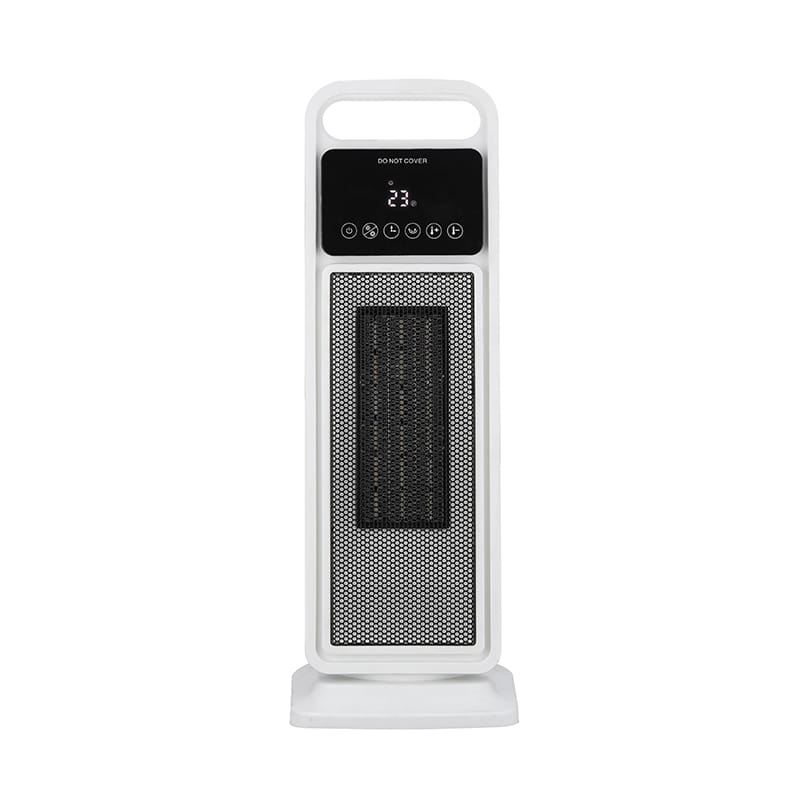 Oscillating Ceramic Tower Heater With Remote ControlA 2000W PTC ceramic tower heater with automatic oscillation and remote control, suited to small rooms where gentle, even warm-air distribution matters.View Product →
For a closer look at how these figures hold up once the thermostat is doing most of the work, see our notes on how energy efficient tower ceramic fan heaters perform in real rooms.
Running Costs by Wattage and Room Size
Wattage still has to match the room, or efficiency claims are meaningless. An undersized heater runs at 100% duty indefinitely; an oversized one short-cycles, which is worse for comfort and no better for the bill. The table below is the sizing logic we use when quoting OEM orders: well-insulated rooms, 2.4 m ceilings, outdoor temperatures around freezing.
| Rated power | Typical heated area | Energy per hour | Cost per hour |
|---|---|---|---|
| 600 W | Desk or personal zone, up to 6 m² | 0.6 kWh | about $0.10 |
| 1,000 W | Bedroom or study, 8 to 12 m² | 1.0 kWh | about $0.17 |
| 1,500 W | Living room, 12 to 18 m² | 1.5 kWh | about $0.26 |
| 2,000 W | Open plan space, 18 to 25 m² | 2.0 kWh | about $0.34 |
| 2,200 to 3,000 W | Large or high-ceiling rooms, 25 to 35 m² | 2.2 to 3.0 kWh | about $0.37 to $0.51 |
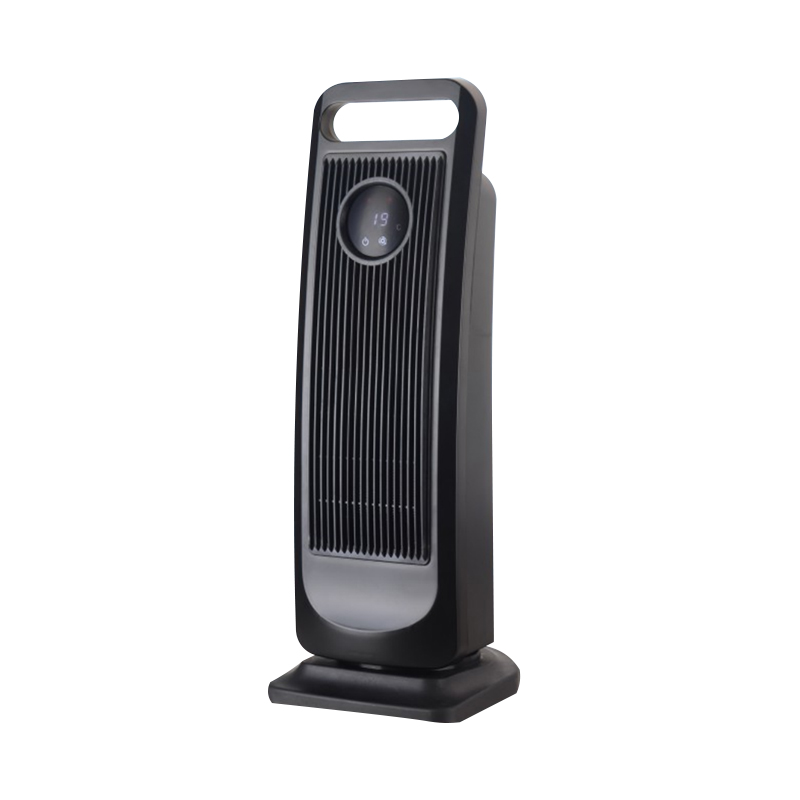 2000W Room Space Heater With Oscillation and RemoteA 2000W PTC ceramic tower heater with two heat settings, automatic oscillation and remote control, built for wide-area room heating with easy mobility.View Product →
What One Evening Actually Costs
The chart below holds the room size constant and varies only the technology and duty cycle, so the difference between the bars is the difference between heating strategies rather than between buildings.
Illustrative arithmetic only: rated power multiplied by hours and an assumed duty cycle, at 17 cents per kWh.
Where Efficiency Is Won or Lost on the Production Line
Most of the difference between a 1,200 W heater that feels warm and a 1,500 W heater that feels cold is manufacturing tolerance, not product concept. Four tolerances decide real-world consumption, and all four are visible on an inspection report.
Four tolerances worth auditing
- Thermostat accuracy. A sensor holding plus or minus 1 °C keeps the room inside a narrow band; one drifting to plus or minus 3 °C forces a full reheating cycle every time it overshoots.
- Oscillation gear train. A nylon-geared synchronous motor stalls under load or develops a hum that leads users to switch the sweep off — and switching it off removes the efficiency benefit entirely.
- Air path and inlet filter. A clogged filter reduces airflow, so the element runs hotter, the overload protection intervenes more often and the duty cycle lengthens.
- Housing fit. Grille gaps of 0.2 to 0.3 mm leak air sideways instead of forward, shortening throw distance and creating exactly the stratification that oscillation is supposed to fix.
Cutaway view: airflow path, element position and sweep geometry inside a slim tower housing.
Ningbo Shuaige Electric Appliance Co., Ltd. builds these units at a 20,000 m² plant in Ningbo and supplies PTC fan heater platforms — tower, portable, fireplace and wall-mounted — to brand owners on an OEM and ODM basis, with production lead times typically quoted at 30 to 60 working days.
A Specification Checklist Before You Commit
Whether you are buying one unit for a home office or a thousand for a retail programme, the same eight points separate a heater that meets its energy claim from one that only meets it on the test bench.
- Power draw at every setting, not just the maximum, measured at the plug.
- Thermostat accuracy, plus the smallest setpoint step the control allows.
- Oscillation angle, sweep speed and whether the gear train is metal or nylon.
- Noise at one metre in low mode, since a loud sweep gets switched off.
- Tip-over switch, overheat cut-out and thermal fuse rating, with test certificates.
- Inlet filter accessibility — a filter the user cannot reach becomes a permanent airflow restriction.
- Certification pack: CE, GS and LFGB where relevant, alongside ISO 9001 and ISO 14001 management records.
- Spare parts availability and MOQ for replacement thermostats, motors and remotes.
 Ultra-Thin Tower Ceramic Electric Heater in Black and SilverA slim 2000W PTC ceramic tower heater with automatic oscillation, remote control and a filter screen, suited to space-conscious rooms where airflow path design matters.View Product →
Slim housings are the hardest to get right on all eight counts, because the airflow path is short and the motor sits close to the element. Auditing one narrow unit will tell you more about a factory than a sample of five bulky ones.
Frequently Asked Questions
Do oscillating tower heaters use a lot of electricity?
A 1,500 W model draws 1.5 kWh per hour at full power, roughly 26 cents at average U.S. rates. With a PTC element and a settling duty cycle, an eight-hour evening usually lands between 5 and 7 kWh in total.
What size room will a 1,500 W tower heater actually heat?
In a well-insulated room with a 2.4 m ceiling, plan on 12 to 18 m² as useful supplementary heat. Above that, the unit simply runs at continuous full power and the efficiency advantage disappears.
Does the oscillation function really lower the bill?
It lowers the bill indirectly. By evening out the temperature profile, it lets the thermostat read a representative sample and hold a setpoint one or two degrees lower, which typically saves 5% to 10% of heating energy per degree.
Are ceramic tower heaters safer than coil heaters?
PTC ceramic surface temperatures run far below nichrome, and the element self-limits its own current. Combined with a tip-over switch and an independent thermal fuse, that gives a wider safety margin in small rooms.
How loud is an energy efficient oscillating tower heater at night?
The element makes no noise; the fan and the sweep motor do. Ask for a measurement at one metre in low mode, and confirm the oscillation gear is metal, since nylon gears are the usual source of ticking.
What certifications should a bulk order include?
For European retail, CE and GS are the baseline, with LFGB relevant to any food-contact parts. ISO 9001 and ISO 14001 records are useful for supplier audits, and a written thermal cut-out test report closes most questions.

-
Feedback
Related products



Copyright© Ningbo Shuaige Electric Appliance Co., Ltd. All Rights Reserved
