

 EN
EN  English
 Deutsch
 中文简体
中文简体 Author: Admin Date: 2026-04-09
How to Choose the Best Tower Fireplace Fan Heater for Your Room?
The best Tower Fireplace Fan Heater for your room is one that matches your room's square footage with the right wattage output, offers genuine ceramic heating technology for consistent warmth, and includes reliable safety features like tip-over protection and overheat shutoff. For most living spaces between 150–300 sq ft, a 1500W flame electric ceramic tower heater delivers both effective heating performance and visual ambiance. Here is everything you need to know to make the right choice.
Content
- 1 Understand Your Room Size and Heating Requirements
- 2 Why Ceramic Heating Technology Makes a Difference
- 3 The Role of the Flame Effect in a Fireplace Heater
- 4 Energy Efficiency: What the Numbers Actually Mean
- 5 Safety Features You Should Never Compromise On
- 6 Control Options and Smart Features Worth Considering
- 7 Design, Size, and Placement Considerations
- 8 Noise Level: An Often Overlooked Factor
- 9 About Ningbo Shuaige Electric Appliance Co., Ltd.
- 10 Frequently Asked Questions
Understand Your Room Size and Heating Requirements
Room size is the single most important factor when selecting a fireplace heater. Purchasing an underpowered unit for a large space leads to inefficiency and discomfort, while an oversized heater wastes energy in a compact room.
As a general rule, 10 watts of heating power is needed per square foot of floor space. Use the table below as a quick reference:
| Room Size (sq ft) | Recommended Wattage | Suitable Heater Type |
|---|---|---|
| Up to 150 sq ft | 750W – 1000W | Compact Tower Heater |
| 150 – 300 sq ft | 1000W – 1500W | Flame Electric Ceramic Tower Heater |
| 300 – 500 sq ft | 1500W – 2000W | High-Output Tower Fireplace Fan Heater |
| 500+ sq ft | 2000W+ | Multi-zone or Dual Heater Setup |
Ceiling height also matters. Standard calculations assume 8-foot ceilings. For rooms with ceilings above 10 feet, add approximately 20% more heating capacity to compensate for the larger air volume.
Why Ceramic Heating Technology Makes a Difference
Not all heater elements are equal. A Flame Electric Ceramic Tower Heater uses a ceramic positive temperature coefficient (PTC) element, which self-regulates its temperature. This means:
- The element automatically reduces power draw when it reaches the target temperature, lowering electricity consumption.
- Surface temperatures stay below 300°F even under heavy load, dramatically reducing fire risks compared to open coil elements.
- Ceramic heaters typically reach full operating temperature in under 3 minutes, making them ideal for quick room warm-ups.
- The technology has a longer service life — quality ceramic elements can last over 10,000 operating hours.
When compared to wire coil heaters, ceramic models are quieter, safer to the touch, and far more energy-efficient in real-world home use.
The Role of the Flame Effect in a Fireplace Heater
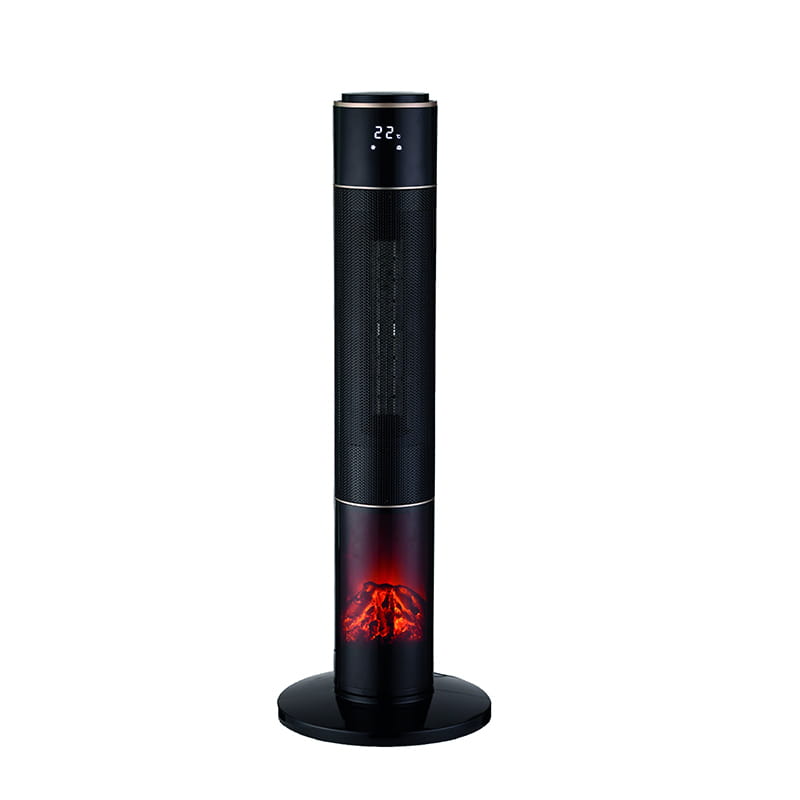
The visual flame effect is a defining feature of a Tower Fireplace Fan Heater. Modern units use LED lighting and reflective materials to simulate realistic fire, providing ambiance without real combustion risk.
Key things to evaluate in a flame effect:
- Flame color options: Premium models offer adjustable flame colors (orange, red, blue) to suit mood and room decor.
- Independent operation: Look for units where the flame effect can run without the heater on, allowing year-round decorative use.
- Brightness adjustment: Dimmable flame brightness is helpful for evening use when you want softer lighting.
- Realistic movement: Multi-layer LED systems create more natural-looking flickering compared to single-layer designs.
Energy Efficiency: What the Numbers Actually Mean
Running a fireplace heater continuously has a direct cost impact. Understanding efficiency metrics helps you choose a model that heats well without excessive energy use.
A 1500W ceramic tower heater running 8 hours a day at a rate of $0.13/kWh costs approximately $1.56 per day. Models with ECO mode or programmable thermostats can reduce this by 20–35%, saving meaningful amounts over a heating season.
Features to prioritize for efficiency:
- Programmable 24-hour timer to avoid heating empty rooms
- Adjustable thermostat with at least 5 temperature settings between 60°F–90°F
- ECO mode that automatically cycles power based on room temperature
- Dual heat settings (750W low / 1500W high) for flexible power management
Safety Features You Should Never Compromise On
Safety is non-negotiable in any fireplace heater, especially in homes with children or pets. Prioritize units that include the following protections as standard:
Tip-Over Protection
An automatic shutoff triggered when the unit is tilted more than 45 degrees prevents fire hazards if the heater is accidentally knocked over. This is essential for tower-format heaters due to their tall, narrow profile.
Overheat Protection
An internal thermal sensor monitors the heating element temperature. If it exceeds a safe threshold — typically around 176°F (80°C) — the unit shuts down automatically and resumes only after cooling.
Cool-Touch Housing
Quality Flame Electric Ceramic Tower Heaters are designed so the outer casing remains below 104°F (40°C) during normal operation, making them safe to touch and safe to use near furniture.
Certification Standards
Always verify that the unit carries internationally recognized safety certifications. The most relevant include:
- ETL / UL – North American electrical safety standard
- CE – European conformity marking covering electrical and safety requirements
- GS / TÜV – German safety marks widely recognized across European markets
- RoHS – Restriction of hazardous substances compliance
Control Options and Smart Features Worth Considering
Modern Tower Fireplace Fan Heaters offer a range of control interfaces. Choosing the right one depends on how and where you use the heater:
| Control Type | Best For | Convenience Level |
|---|---|---|
| Manual Button Panel | Simplicity, durability | Basic |
| Remote Control | Adjustments from sofa or bed | High |
| Digital Thermostat Display | Precise temperature control | High |
| App / Wi-Fi Control | Smart home integration, scheduling | Very High |
For most households, a remote control combined with a digital thermostat covers all practical needs. Smart app control is valuable for users who want to pre-heat a room before arriving home or integrate heating into an automated schedule.
Design, Size, and Placement Considerations
A Tower Fireplace Fan Heater is as much a home decor piece as a heating appliance. Before purchasing, consider:
- Height and footprint: Most tower heaters range from 24 to 42 inches tall. Taller units distribute heat more evenly in larger rooms.
- Oscillation: A 70°–90° oscillation feature distributes warm air across a wider area, which is particularly useful in open-plan living spaces.
- Color and finish: Black and dark wood-finish models integrate well with contemporary and traditional interiors alike.
- Placement: Position the heater at least 3 feet from furniture, drapes, or bedding. Avoid enclosed alcoves that restrict airflow.
- Portability: Look for integrated carry handles and a cord management system for easy repositioning between rooms.
Noise Level: An Often Overlooked Factor
Heater noise is frequently underestimated during the purchasing process. A unit that operates loudly disrupts sleep, conversation, and focus. Ceramic fan heaters typically operate between 35–50 dB, comparable to a quiet library or refrigerator hum.
When choosing a heater for a bedroom or study, prioritize models that specify a noise level of 45 dB or lower on their low heat setting.
About Ningbo Shuaige Electric Appliance Co., Ltd.
Ningbo Shuaige Electric Appliance Co., Ltd. is a China Tower Fireplace Fan Heater Manufacturer and OEM/ODM Tower Fireplace Fan Heater Company, covering an area of 20,000m². With over 15 years of experience, the factory has become the OEM provider to some world-famous brands. The continuous efforts on research and development and the concentration on quality control have brought long-term and reliable orders from all over the world, including Europe, Southeast Asia, East Asia, the Middle East, South Africa, Oceania, South America, and more. Every Tower Fireplace Fan Heater and Flame Electric Ceramic Tower Heater produced at the facility is engineered to meet international safety and performance standards, ensuring end users receive a product that is both reliable and built to last.
Frequently Asked Questions

-
Feedback
Related products



Copyright© Ningbo Shuaige Electric Appliance Co., Ltd. All Rights Reserved
